Nat Eliason – Build Your Own Apps
Original price was: $ 499.00.$ 26.00Current price is: $ 26.00.
build your own apps
app development guide
no-code app creation
digital product development
Instant Delivery, You Will Find Download Link In Thank You Page After You Complete Payment Proccess.
- 24/7 Contact Support & Fast Chat
- You Can Request Any Courses
- Original Courses HD Qualite And Links Updated
- We Accept Crypto Payments
Description
Nat Eliason – Build Your Own Apps Download
Build Your Own Apps
Build Your Own Apps COURSE
Build Your Own Apps BY Nat Eliason
Nat Eliason – Build Your Own Apps Download: The No-Code Revolution You Can’t Afford to Miss
What If You Could Build Your Own Apps Without Writing a Single Line of Code?
Here’s a stat that should stop you in your tracks: the global no-code development market is projected to reach $65 billion by 2027, growing at a compound annual rate of 28.1% (Gartner, 2023). Yet most people still believe that building software is exclusively the domain of engineers with years of formal training.
Nat Eliason is here to dismantle that myth – one app at a time.
If you’ve been searching for Nat Eliason’s Build Your Own Apps course or looking for a legitimate download, you’ve landed in exactly the right place. In this comprehensive guide, we’ll walk you through everything you know about this revolutionary program: what’s inside it, who it’s designed for, how to access it, and whether it’s truly worth your time and investment.
Build your own apps isn’t just a catchy phrase — it’s a movement redefining who gets to participate in the software economy. And Nat Eliason is leading the charge.
What Is “Build Your Own Apps” by Nat Eliason?
Build Your Own Apps is a self-paced online course created by Nat Eliason — entrepreneur, writer, and founder of Growth Machine — that teaches complete beginners how to design, build, and launch functional software applications using AI-powered no-code tools, primarily Claude AI and Cursor.
Rather than teaching traditional programming, the course leverages the latest generation of large language models (LLMs) to do the heavy lifting. You describe what you want, and the AI writes the code. Your job is to direct, refine, and deploy.
The course is structured around a simple but powerful promise: anyone with an idea can now build working software, regardless of their technical background.
Who Is Nat Eliason?
Nat Eliason is a well-known figure in the indie hacker, creator economy, and self-improvement space. He’s the author of Effortless Output in Roam, co-host of the Made You Think podcast, and founder of Growth Machine — an SEO agency. He’s also a prolific blogger at nateliason.com, where he covers productivity, business, and now — software development for non-technical founders.
His credibility stems not from academic credentials, but from documented results: he has built and launched multiple working applications himself using the exact techniques he teaches.
What’s Inside the Course? (The Full Curriculum Breakdown)
Think of this section as your ingredient list — the building blocks that make up the Build Your Own Apps experience. Here’s what the course delivers:
🧱 Core Modules & Topics Covered
- Module 1: The AI-Assisted Development Mindset Understanding how to think like a product manager rather than a programmer. This shift in mental model is foundational.
- Module 2: Setting Up Your Tech Stack A guided walkthrough of tools including Cursor, Claude, Replit, Supabase, and Vercel — the modern no-code/low-code toolkit for indie builders.
- Module 3: Building Your First App Start from zero and end with a deployed, functional application. Step-by-step prompting strategies to get the AI to generate reliable, working code.
- Module 4: Debugging and Iteration Learn how to identify what’s broken (even without reading code) and instruct AI to fix it. This module alone saves hours of frustration.
- Module 5: Database Design and Management Using Supabase to handle user data, authentication, and storage — explained in plain English.
- Module 6: Deployment and Going Live How to publish your app on Vercel and make it accessible to the world in under an hour.
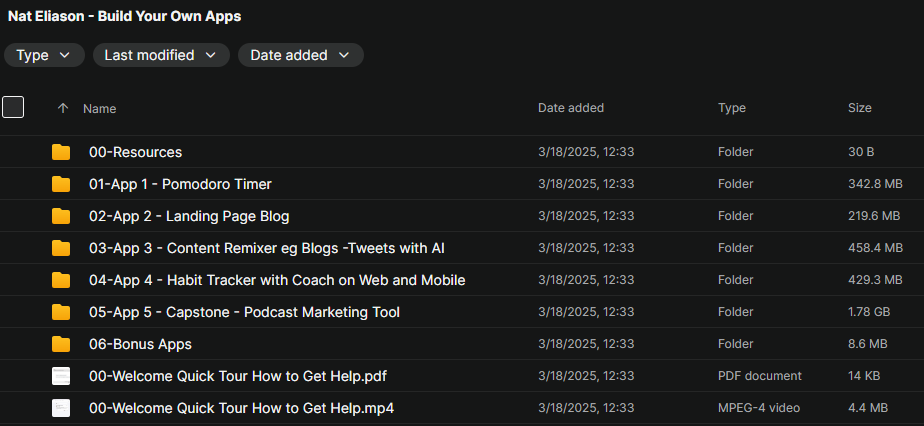
- Module 7: Building Real-World Projects Case studies and walkthroughs of actual apps Nat (and students) have built — from internal tools to SaaS micro-products.
- Bonus: Prompting Templates & Cheat Sheets Pre-built prompt frameworks you can copy and paste to accelerate your builds.
📦 Deliverables & Downloads
Upon enrollment, students typically receive:
- Lifetime access to course videos
- Downloadable prompt templates
- Access to a private community or Discord
- Regular content updates as AI tools evolve
- Project starter files and code scaffolding (varies by enrollment tier)
Step-by-Step: How to Access and Get Started With Build Your Own Apps
Step 1: Find the Official Course Page
Navigate to nateliason.com and look for the “Build Your Own Apps” course in the navigation menu or the products/courses section. Be cautious of third-party sites claiming to offer “free downloads” — always purchase directly from Nat’s official platform to ensure you receive legitimate access, updates, and community support.
⚠️ Important Note on Downloads: “Build Your Own Apps download” often refers to the downloadable assets (templates, cheat sheets, starter files) that come with the course — not a pirated version of the content. Support creators by purchasing legitimately; it also ensures you get ongoing updates as AI tools change rapidly.
Step 2: Choose Your Enrollment Tier
Nat typically offers multiple access tiers. Review what’s included at each level — community access, 1-on-1 sessions, or bonus project walkthroughs may be available at higher tiers.
Step 3: Set Up Your Development Environment
Before watching a single video, get your tools ready:
- Create a free Cursor account (cursor.sh)
- Sign up for Claude at claude.ai (Pro plan recommended for course work)
- Set up a Supabase account (free tier available)
- Create a Vercel account for deployment (free tier available)
Having these in place before starting Module 1 will eliminate friction and let you follow along in real time.
Step 4: Follow the Modules in Order
Resist the urge to skip ahead. The course is sequenced intentionally — each module builds on the mental models and technical setup from the previous one.
Step 5: Build Alongside the Videos
The most successful students build as they watch, not after. Pause. Implement. Unpause. This active learning approach accelerates retention dramatically.
Step 6: Ship Something Real
The goal isn’t to finish the course — it’s to launch an app. Even if it’s small, imperfect, or only used by you and three friends, shipping something real is the entire point.
Healthier Alternatives: Complementary Resources to Pair With This Course
To maximize your results with Build Your Own Apps, consider supplementing with:
- “The Mom Test” by Rob Fitzpatrick — Learn how to validate your app idea before building it. Saves enormous time.
- Superhuman AI Newsletter — Stay current on the AI tools landscape as it evolves.
- Buildspace (nights & weekends) — A free community program for builders launching projects.
- Lenny’s Newsletter — Product strategy and startup tactics for indie builders.
- Nat Eliason’s own blog — His posts on AI development, productivity, and building in public are directly relevant.
For those wanting more technical depth alongside the course, freeCodeCamp’s JavaScript Basics (free, ~300 hours) can help you understand what the AI is writing — even if you never write it yourself.
Serving Suggestions: Who Gets the Most From This Course?
Build Your Own Apps is best suited for:
- Entrepreneurs and solopreneurs with software ideas but no technical co-founder
- Marketers and growth hackers who want to build internal tools
- Content creators looking to build subscription products or membership tools
- Consultants who want to productize their services into software
- Side project enthusiasts who’ve always had an app idea but never acted on it
- Non-technical startup founders who need to build an MVP quickly
It is less ideal for:
- People looking for deep computer science education
- Those wanting to build complex, enterprise-scale applications
- Developers already fluent in a programming language (though the AI workflow tips are still valuable)
Common Mistakes to Avoid When Taking This Course
❌ Mistake 1: Trying to Download a “Free” Version
Pirated course content is always a bad idea — outdated, incomplete, and ethically wrong. More practically: AI tools like Cursor and Claude update constantly, and Nat updates the course accordingly. A six-month-old pirated version may be significantly out of date.
❌ Mistake 2: Watching Without Building
Passive consumption is the graveyard of online courses. Studies show that active recall and practice improve retention by up to 75% compared to passive re-reading (Roediger & Karpicke, 2006). Build as you go.
❌ Mistake 3: Aiming Too Big for Your First App
The most common reason students don’t finish: their first idea is too complex. Start with a one-feature app. A simple bookmark manager. A personal habit tracker. A quote generator. Complexity can come later.
❌ Mistake 4: Skipping the Prompting Modules
The quality of what you build is directly proportional to the quality of your prompts. Students who rush past Nat’s prompting frameworks consistently struggle more in later modules.
❌ Mistake 5: Not Joining the Community
Whether it’s a Discord, Circle community, or forum — the peer group around a course is often more valuable than the content itself. Don’t isolate your learning.
Storing Tips: How to Retain and Apply What You Learn
Great knowledge without application decays fast. Here’s how to preserve and compound what you learn from Build Your Own Apps:
- Build a second app within 30 days of completing the course while concepts are fresh
- Document your projects in a public place (Twitter/X, a blog, GitHub) — accountability accelerates mastery
- Revisit the prompting templates every few months; your understanding of them deepens with experience
- Follow Nat’s updates — he posts regularly about new AI tools and techniques that extend the course material
- Teach someone else — explaining what you’ve learned to a friend or writing about it is the highest-retention activity known to learning science
Conclusion: Is Build Your Own Apps Worth It?
Nat Eliason’s Build Your Own Apps represents something genuinely new in online education: a practical, no-nonsense curriculum that equips non-technical people to participate in software creation using the most powerful AI tools available today.
In a world where software is eating everything, the ability to build your own apps — even simple ones — is a superpower. This course hands you that superpower in 15–30 focused hours.
Ready to build something? Head to nateliason.com, enroll in Build Your Own Apps, and start your first project this week. Have questions or feedback? Drop a comment below — we read every one. And if you want more guides like this, subscribe to our newsletter for weekly breakdowns of the best creator economy tools and courses.
Frequently Asked Questions (FAQs)
Q1: Do I need any coding experience to take Build Your Own Apps?
A: No. The entire premise of the course is that you don’t need to write code — the AI does that. You need curiosity, a clear product idea, and the willingness to follow instructions carefully.
Q2: Where can I find the official Build Your Own Apps download?
A: The course and all downloadable materials (templates, cheat sheets, starter files) are available exclusively through Nat Eliason’s official website at nateliason.com. Avoid third-party download sites, which often distribute outdated or incomplete content.
Q3: How much does the course cost?
A: Pricing varies and may change over time. Visit nateliason.com directly for current pricing and any available payment plans or promotional offers.
Q4: What tools do I need to take this course?
A: The primary tools are Cursor (AI-powered code editor), Claude AI, Supabase (database), and Vercel (deployment). All have free tiers sufficient for course projects, though a Claude Pro subscription (~$20/month) is recommended for heavier use.
Q5: How is this different from other no-code tools like Bubble or Webflow?
A: Traditional no-code platforms like Bubble use visual drag-and-drop interfaces with proprietary systems. Nat’s approach uses real code generated by AI — meaning your apps are more flexible, portable, and scalable. You’re not locked into any platform’s ecosystem.
Q6: Can I really build a sellable product after taking this course?
A: Yes — and many students have. The course specifically includes guidance on building real-world, deployable applications. Whether you can sell it depends on your idea, execution, and marketing — the course gives you the technical building blocks.
Q7: Is the course updated regularly?
A: Nat has a track record of updating his materials as AI tools evolve — which in this space means frequently. This is one of the strongest arguments for purchasing the official version rather than seeking a download from unofficial sources.
SALE PAGE : https://www.buildyourownapps.com/
Related products
-
Sale!

OrderFlows – 10 Weeks Summer Program 2025 – Mike Valtos
Original price was: $ 497.00.$ 25.00Current price is: $ 25.00. -
Sale!
Razvan Paraschiv – Grow Channels Accelerator
Original price was: $ 6,000.00.$ 35.00Current price is: $ 35.00. -
Sale!
ConversionXL CXL – All Access Pass 2025
Original price was: $ 997.00.$ 29.85Current price is: $ 29.85. -
Sale!
Troy Broussard – Low Stress Options
Original price was: $ 2,000.00.$ 31.97Current price is: $ 31.97.


Reviews
There are no reviews yet.